


Table of Contents
Quick Answer
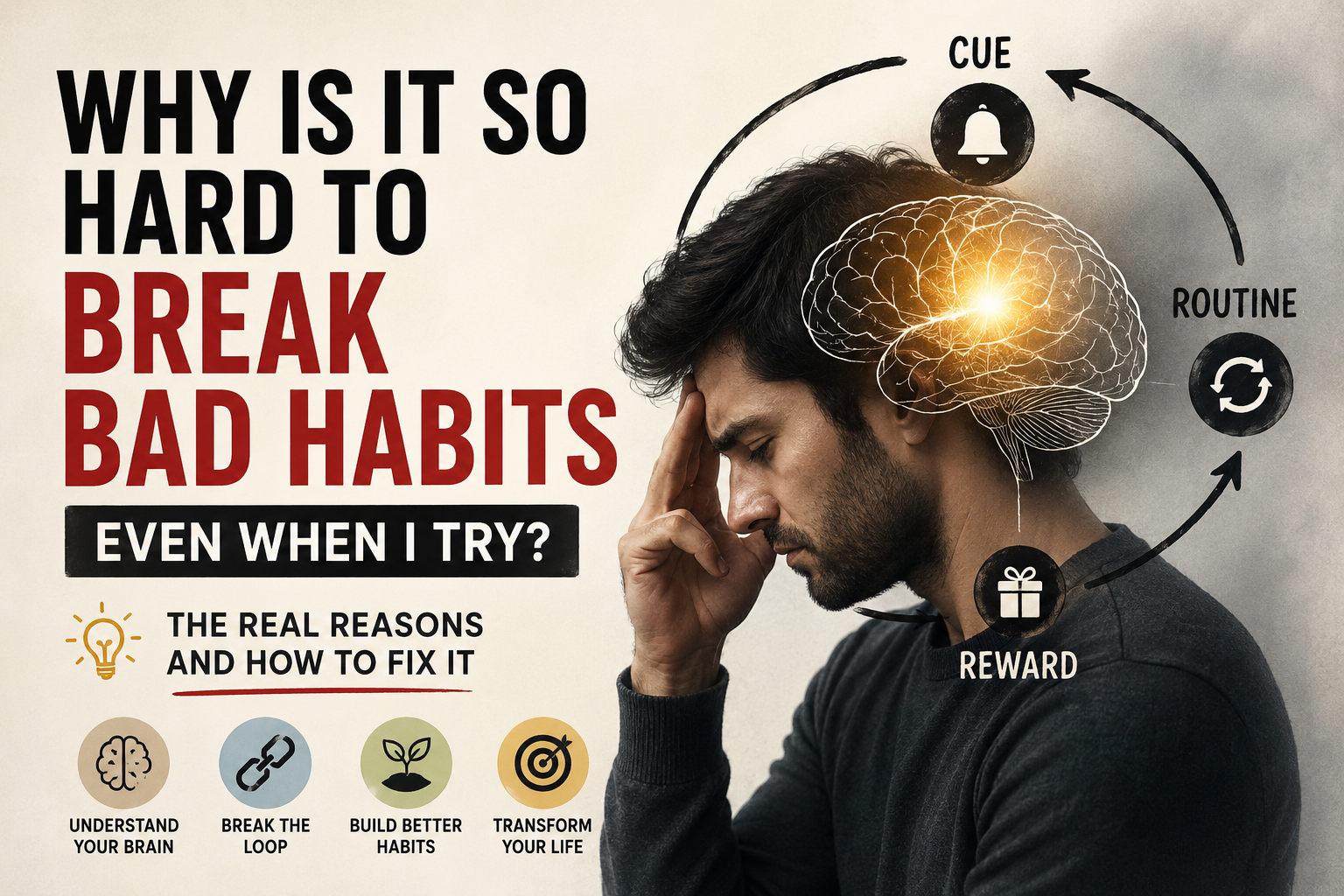
It is hard to break bad habits because they run on an automatic loop in the brain: cue → routine → reward. Even when you try to stop, your brain still seeks the reward it expects from the habit, which makes willpower alone ineffective.
📌 Key Takeaways
- If you keep repeating a bad habit, it doesn’t necessarily mean you lack discipline.
- Bad habits often provide instant comfort, which makes them difficult to resist.
- Motivation fades quickly, but habit loops can last for years.
- The most effective way to stop a bad habit is to replace it with a better one.
- Changing your environment is often easier than relying on willpower alone.
Why Do I Keep Repeating Bad Habits Automatically?
You are not actively choosing the habit every time.
Your brain has already automated it.
Every habit follows a loop:
- Cue: something triggers the behavior (stress, boredom, phone notification)
- Routine: you repeat the action (scrolling, eating, procrastinating)
- Reward: you get relief, distraction, or pleasure
This process is explained in Atomic Habits and The Power of Habit.
Once repeated enough times, the brain turns it into an automatic pattern.
Blocking digital triggers can interrupt the habit cycle before it starts.
👉 Freedom App: The Ultimate Tool to Block Distractions and Boost Focus
Why Are Bad Habits So Hard to Stop?
Bad habits are hard to stop because they solve a feeling instantly.
They often provide quick relief from:
- stress
- boredom
- anxiety
- fatigue
Dopamine Nation explains this as the brain preferring fast rewards over delayed effort.
So even when you know the habit is harmful, your brain still chooses it because it works immediately.
Why Doesn’t Willpower Work to Break Bad Habits?
Willpower fails because habits are not conscious decisions.
Here’s why:
- your environment triggers the behavior automatically
- repetition is stronger than intention
- motivation fades quickly
- stress reduces self-control
This is why you can feel motivated in the morning and still repeat the habit later.
Use browser-level control tools to reduce temptation and enforce focus.
👉 StayFocusd: How This Chrome Extension Boosts Your Productivity by Blocking Distractions
How Do You Actually Break a Bad Habit?
You don’t break habits by forcing yourself.
You break them by changing the loop.
1. Identify What triggers your bad habit?
Identify the pattern:
- When does it happen?
- What emotion comes before it?
- What situation triggers it?
Awareness is the first control point.
Grayscale Mode can help reduce visual triggers that reinforce compulsive phone use.
👉 Grayscale Mode: The Simple Phone Hack to Control Screen Addiction and Reduce Mindless Scrolling
2. Replace the habit, don’t remove it
Your brain needs a substitute behavior.
Examples:
- scrolling → short walk
- stress eating → drink water or pause
- procrastination → start for 2 minutes
3. Make the new habit rewarding
Your brain repeats what feels rewarding.
So make the new behavior:
- easier
- satisfying
- immediately rewarding (even slightly)
Improving mood naturally can reduce relapse into unhealthy habits.
👉 Quick Natural Mood Boosters: Science-Backed Ways to Feel Better Fast
To sum up
You don’t break bad habits by fighting them.
You break them by redesigning them.
Habits are not removed. They are replaced with better loops.
References:
People Also Ask About Breaking Bad Habits :
Can bad habits really be changed?
Yes. Most habits can be changed by identifying triggers, replacing routines, and repeating healthier behaviors over time.
Why do I keep going back to bad habits?
Bad habits often provide immediate rewards such as comfort, distraction, or relief. During stress or fatigue, the brain tends to return to familiar reward patterns.
How long does it take to break a bad habit?
There is no fixed timeline. Consistency and repetition are usually more important than reaching a specific number of days.
Is willpower enough to break bad habits?
Not usually. Willpower can help in the short term, but lasting change often requires modifying triggers, routines, and environments.
What is the best way to replace a bad habit?
The most effective approach is to keep the same trigger but swap the unwanted behavior for a healthier alternative that provides a similar reward.