


Table of Contents
Most people check their phones many times per day without any clear intention. You unlock your device, scroll briefly, and sometimes forget why you even picked it up. This behavior is often interpreted as distraction or lack of discipline. However, modern neuroscience and behavioral science suggest a different explanation: it is an automatic reward-based habit loop shaped by the brain’s learning system.
As explained in Dopamine Nation by psychiatrist Dr. Anna Lembke, modern environments provide frequent, high-intensity stimulation that interacts directly with the brain’s reward system, reinforcing repetitive behaviors over time.
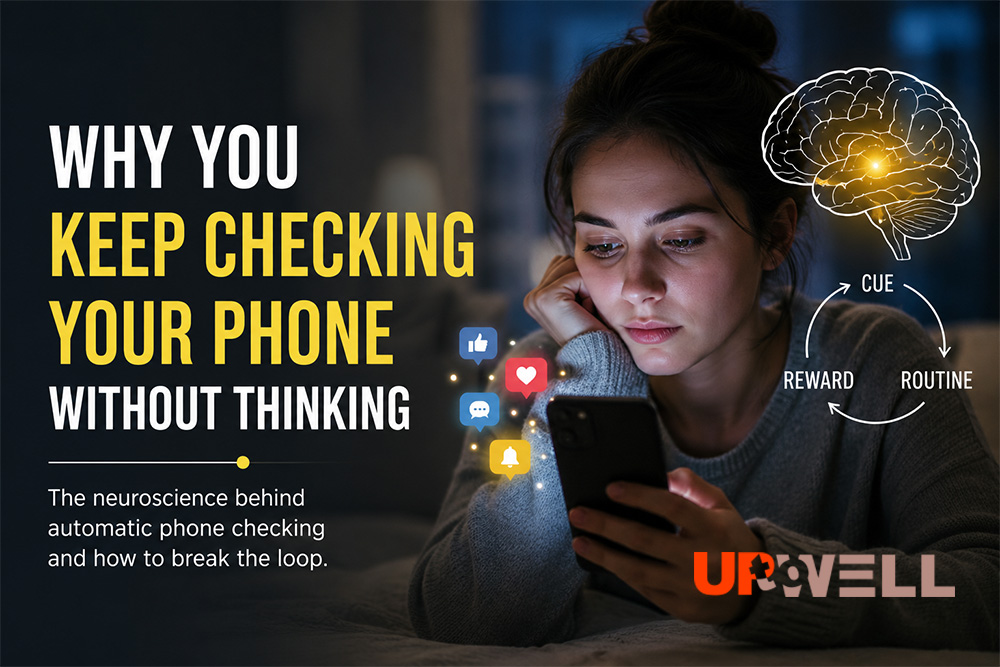
People keep checking their phones because the brain’s dopamine system reinforces reward-seeking behavior. Over time, repeated phone use forms a habit loop made of cue, routine, and reward, which makes the behavior automatic rather than consciously controlled.
Dopamine and the brain’s reward system
Dopamine is a neurotransmitter involved in motivation, learning, and reward prediction. It is not simply a “pleasure chemical,” but rather a system that helps the brain determine what is worth repeating. According to research by Wolfram Schultz, dopamine neurons encode reward prediction errors, meaning the brain learns from the difference between expected and actual outcomes.
In practical terms:
The brain strengthens behaviors that seem rewarding or potentially rewarding in the future.This mechanism helps explain why repeated phone checking becomes increasingly automatic over time.
Why “wanting” is stronger than “liking”
Neuroscientists Kent Berridge and Terry Robinson describe a key distinction in motivation systems:
- “Liking” = actual pleasure
- “Wanting” = motivational drive to repeat behavior
Their incentive salience theory explains that dopamine is more closely related to “wanting” than “liking.”
This means:
- You may not enjoy every phone check
- But you still feel compelled to check it
This distinction is important for understanding habitual smartphone use.
How habit loops form (cue → routine → reward)
Behavioral scientist Charles Duhigg describes habit formation as a loop:
- Cue → trigger (boredom, waiting, silence)
- Routine → phone checking
- Reward → novelty, social input, stimulation
Over time, this loop becomes automatic. The brain begins to initiate the behavior without conscious decision-making, especially in low-stimulation moments.
Why smartphones are especially powerful triggers
Smartphones are particularly effective at reinforcing this loop because they deliver variable rewards. You never know what you will find when you check them.
This unpredictability strengthens behavioral reinforcement, making the habit more persistent over time.
Why the behavior becomes automatic (not a willpower issue)
One of the key insights from habit research (including Duhigg’s model) is that habits are primarily driven by context, not conscious decision-making.
This means:
- The environment triggers the behavior
- Not a deliberate choice each time
This is why people often reach for their phones during:
- boredom
- waiting moments
- emotional pauses
- transitions between tasks
The behavior becomes a learned response to context.
Modern overstimulation and dopamine adaptation
In Dopamine Nation, Dr. Lembke explains that repeated exposure to high-reward stimuli can shift the brain’s baseline, making ordinary experiences feel less engaging over time.
In behavioral terms, this can lead to:
- increased stimulation seeking
- reduced tolerance for boredom
- stronger habitual checking behavior
This does not mean damage in a clinical sense, but rather adaptation of reward sensitivity.
How to reduce automatic phone checking
Behavioral science suggests that changing the environment is more effective than relying on willpower alone.
1. Increase friction
Make the behavior slightly harder:
- move apps off the home screen
- disable unnecessary notifications
- keep the phone out of immediate reach
2. Reduce triggers
- minimize visual alerts
- limit notification frequency
- avoid constant background stimulation
3. Replace the automatic response
When the urge appears:
- pause briefly
- take a breath
- perform a simple alternative action (e.g., stretch, walk, drink water)
4. Reintroduce low-stimulation moments
Short periods of boredom or reduced input help the brain reduce dependency on constant stimulation.
➜ Grayscale Mode Guide: A simple phone setting that can help reduce mindless scrolling.
All in all, Phone checking is not primarily a discipline problem. It is a learned behavioral loop reinforced by the brain’s reward and habit systems.
Once the mechanism is understood, the solution shifts from self-control to environment design and pattern interruption.
This is the most effective way to reduce automatic phone use and regain control over attention.
References:
- Anna Lembke – Dopamine Nation : https://www.annalembke.com/dopamine-nation
- Wolfram Schultz – dopamine reward prediction (Nobel Prize press release) : https://www.nobelprize.org/prizes/medicine/2000/press-release/
- Kent C. Berridge & Terry E. Robinson – incentive salience theory : https://www.ncbi.nlm.nih.gov/pmc/articles/PMC2876988/
- Charles Duhigg – The Power of Habit : https://charlesduhigg.com/the-power-of-habit/